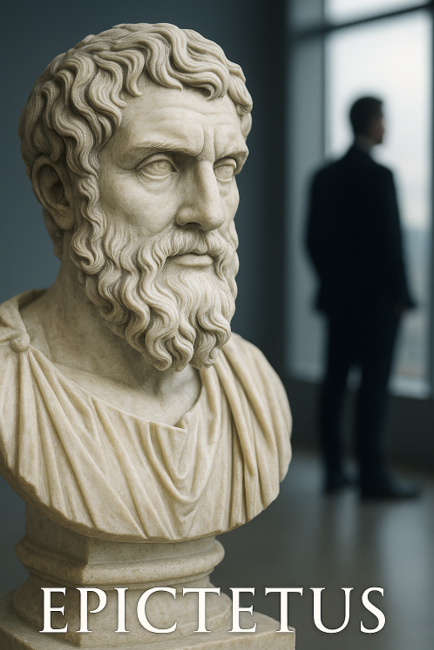
What Epictetus Can Teach Leaders About Control, Accountability, and Performance
There is a moment in every leader’s career when the market turns, a plan slips, or an unexpected shock hits the business. Phones light up, inboxes fill, and the pressure to “fix everything” becomes overwhelming. In those moments, many leaders try to control forces that are fundamentally beyond them, such as macroeconomic trends, customer sentiment, or regulatory outcomes. The result is frustration, reactive decision‑making, and exhausted organizations.
Epictetus, the Stoic philosopher, offers a different and surprisingly practical leadership framework. His core insight is simple: focus relentlessly on what is within your control, namely your decisions, behavior, priorities, and actions, and accept that outcomes themselves can never be fully controlled.
“Some things are up to us, and some things are not.”
This single sentence captures a discipline that modern leaders desperately need. It is not a call for passivity or detachment, but for clarity and responsibility. In business terms, it is a framework for sustainable performance, especially under pressure.
The Dichotomy of Control as a Leadership Filter
Epictetus divided life into two categories. First, there are things that are up to us, such as our judgments, intentions, communication, and effort. Second, there are things that are not, including market movements, competitors’ actions, regulatory decisions, and ultimately other people’s reactions.
For leaders, this distinction acts as a powerful decision filter. You do not control market demand, but you control the quality of your forecast, pricing discipline, and cost management. You do not control regulatory change, but you control preparedness, compliance processes, and response speed. You do not control how employees feel about bad news, but you control how clearly, honestly, and respectfully you communicate it.
Leaders who consistently apply this filter reduce noise and sharpen priorities. Meetings become more focused. Teams spend less time speculating about external forces and more time improving execution. Performance discussions shift away from excuses and toward ownership.
Where Leaders Struggle: Confusing Control with Influence
The most common leadership failure is not ignorance of the dichotomy of control, but confusion between control and influence.
Influence matters. Leaders influence culture, customer trust, investor confidence, and employee engagement. However, influence increases probability rather than guarantees outcomes. When leaders treat influence as control, several problems emerge.
First, leaders over‑promise. Targets become commitments rather than ambitions supported by controllable actions. When reality intervenes, credibility suffers.
Second, organizations develop blame cultures. When results fall short, attention shifts to assigning fault instead of learning. This erodes trust and discourages transparency.
Third, leaders become emotionally volatile. Their mood follows external events rather than internal discipline, and the organization mirrors that instability.
Epictetus would argue that true leadership strength comes from anchoring identity in decision quality and integrity, not in outcomes alone. Results matter, but they are best achieved by mastering what is genuinely within one’s control.
Applying Stoic Thinking to Executive Decision‑Making
The value of Epictetus becomes especially clear in high‑pressure executive situations.
In earnings communication, leaders cannot control market reaction, but they can control clarity, consistency, and honesty. A disciplined leader separates facts from interpretations, acknowledges uncertainty, and ties guidance to concrete operational actions. Even difficult messages build trust when delivered with precision and credibility.
In audits and regulatory reviews, leaders cannot dictate outcomes or timing, but they can control readiness. Documentation quality, process ownership, and issue escalation are all controllable. A Stoic approach replaces defensiveness with professionalism and turns audits into continuous discipline rather than annual stress events.
In crises, emotional control becomes decisive. Stoic leadership starts by stabilizing perception. Leaders ask what the facts are, what decisions are required now, and who owns them. Calm leadership is not denial; it is the foundation for effective action. Teams take cues from the most composed person in the room.
In strategy execution, leaders cannot force market adoption, but they can design learning loops. Clear ownership, measurable assumptions, fast feedback, and willingness to adjust are all within control. Strategy becomes a practice rather than a declaration.
Accountability Without Blame
One of the most powerful implications of Epictetus’s philosophy is its impact on accountability. Stoicism does not reject responsibility. Instead, it refines it.
Rather than asking who is at fault, Stoic leadership asks whether decisions were sound, assumptions reasonable, and actions timely, given the information available at the time. This separates accountability from shame and creates psychological safety without lowering standards.
Organizations that adopt this mindset learn faster. People surface risks earlier. Mistakes become inputs for improvement rather than sources of fear. Over time, performance becomes more resilient because it is grounded in learning rather than punishment.
Practical Leadership Behaviors
Translating Stoic philosophy into daily leadership practice requires discipline.
Leaders can begin by structuring reviews around controllables before outcomes. They can document what is truly within control for major risks and align mitigations accordingly. They can use precise language that ties commitments to actions rather than promises results alone.
In moments of stress, leaders can rely on clear decision rhythms that move from facts to options to ownership. Calm, in this sense, is a process choice rather than a personality trait.
Performance management should reward decision quality, learning speed, and control effectiveness, not only results. Over time, these behaviors become leading indicators of sustainable outcomes.
The Performance Advantage
Leaders who follow Epictetus’s discipline do not withdraw from responsibility. They become more effective. They waste less energy on what they cannot change and more on execution. Their organizations become clearer, calmer, and more resilient.
In an environment defined by volatility and constant pressure, the ability to focus on what truly depends on you is a competitive advantage. Epictetus reminds leaders that freedom, credibility, and performance begin with one question: What is actually within my control right now?
That question, asked consistently, changes everything.